



Why More Couples in Thane Are Turning to Ayurveda for Infertility Solutions — Trends & Benefits.

Living in Thane comes with its own unique pace. It is a city of rapid growth, bustling connectivity, and ambition. However, for many couples juggling the demands of modern life—long commutes on Ghodbunder Road, high-pressure corporate jobs, and shifting dietary habits—there is a silent struggle growing behind closed doors: Infertility.

Living in Thane comes with its own unique pace. It is a city of rapid growth, bustling connectivity, and ambition. However, for many couples juggling the demands of modern life—long commutes on Ghodbunder Road, high-pressure corporate jobs, and shifting dietary habits—there is a silent struggle growing behind closed doors: Infertility.  While modern reproductive treatments like IUI and IVF are well-known, a significant trend is emerging across the city. More couples are pausing, stepping back from invasive procedures, and turning to the ancient wisdom of Ayurveda.  At Narkhede Ayurved, led by Dr. Sagar Narkhede, we have witnessed this shift firsthand. But why is Ayurveda becoming the preferred choice for aspiring parents in Thane? Let’s explore the trends and benefits.  The "Thane Lifestyle" and Fertility Infertility is no longer just a medical condition; it is often a lifestyle disorder. In Ayurveda, we view the body as a whole ecosystem. The stress of urban living, irregular sleep patterns, and exposure to pollution can disrupt the Doshas (body energies), leading to:  Hormonal imbalances (PCOS/PCOD).  Reduced sperm quality and motility.  Poor egg health.  Blocked fallopian tubes.  Modern medicine often rushes to "fix" the symptom. Ayurveda asks a different question: Why is the body preventing conception in the first place?  Why the Shift to Ayurveda? Couples are increasingly seeking solutions that are natural, restorative, and free from the heavy side effects of hormonal injections.  1. Root-Cause Treatment (Not Just Symptom Management) Unlike treatments that force ovulation or fertilization, Ayurveda focuses on Beejshudhi (Seed Purification). This process detoxifies the reproductive tissues (Shukra Dhatu) in both partners, ensuring that the sperm and ovum are genetically and physically healthy before conception occurs.  2. The Power of Uttarbasti One of the most sought-after treatments at our Thane clinic is Uttarbasti. This specialized therapy involves administering medicated oils or decoctions directly into the uterus or bladder.  For Women: It is highly effective for clearing tubal blockages, strengthening the uterine lining, and treating PCOD/PCOS.  For Men: It helps address strictures and improves sperm parameters.  Note: Many of our patients who had previously failed IVF cycles found success after a course of Uttarbasti.  3. Stress Management & Mental Health Fertility is deeply connected to your mental state. High cortisol (stress hormone) levels can suppress reproductive hormones. Through therapies like Shirodhara and specialized stress-management protocols, we prepare the mind for parenthood, not just the body.  Dr. Sagar Narkhede’s Approach: Holistic & Personalized At Narkhede Ayurved, we believe that no two couples are the same. Dr. Sagar Narkhede utilizes Nadi Pariksha (Pulse Diagnosis) to understand your unique constitution. Whether you are dealing with male infertility, irregular cycles, or unexplained infertility, the treatment plan is customized to your body.  Our Success Stories Speak Volumes  We have been privileged to help couples who had struggled for years—some for over a decade—finally achieve their dream of parenthood. By combining Panchakarma detox therapies with precise herbal medications, we restore the body's natural fertility rhythm.  Start Your Journey to Parenthood If you are tired of treatments that feel mechanical or invasive, it might be time to look at the root cause. Nature has a way of healing, sometimes it just needs the right guidance.


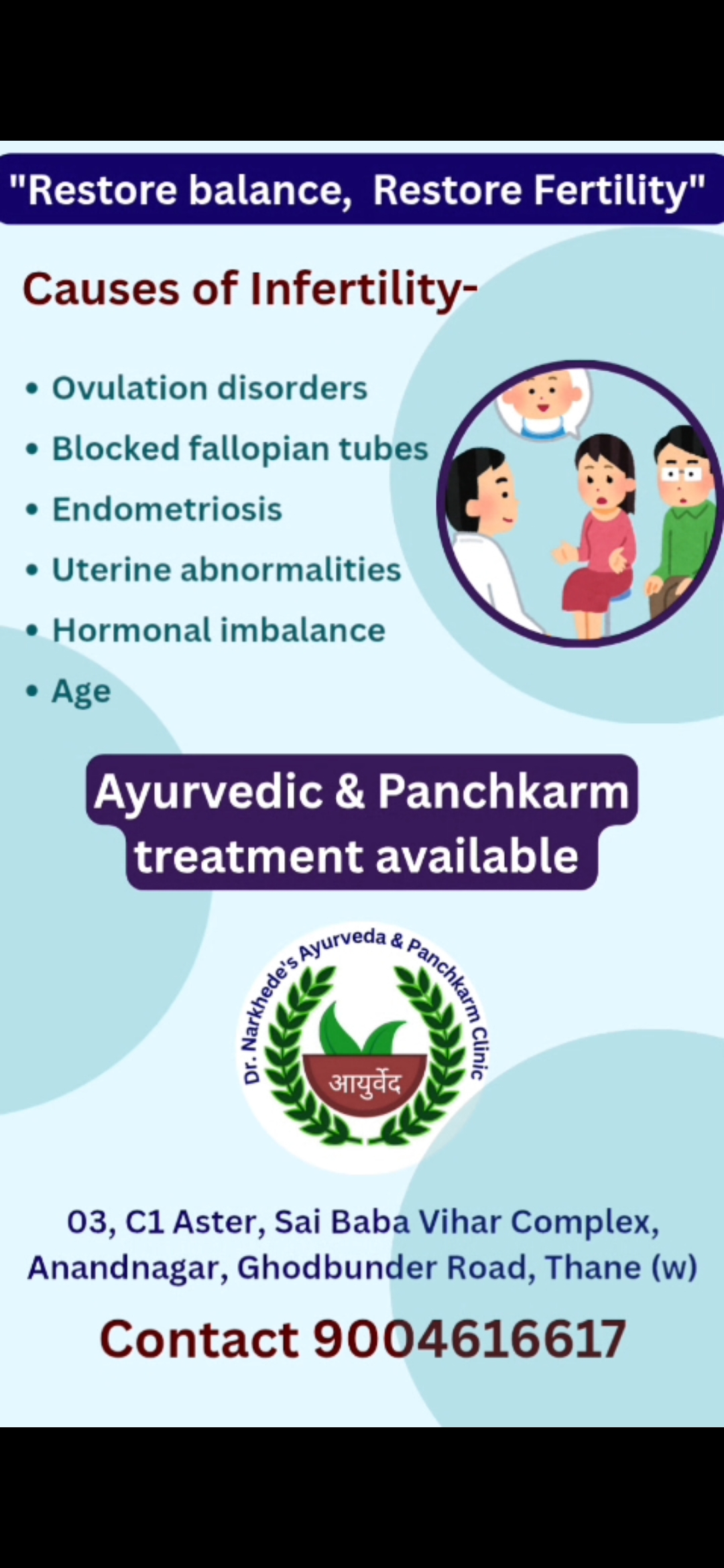
While modern reproductive treatments like IUI and IVF are well-known, a significant trend is emerging across the city. More couples are pausing, stepping back from invasive procedures, and turning to the ancient wisdom of Ayurveda.

At Narkhede Ayurved, led by Dr. Sagar Narkhede, we have witnessed this shift firsthand. But why is Ayurveda becoming the preferred choice for aspiring parents in Thane? Let’s explore the trends and benefits.

The "Thane Lifestyle" and Fertility

Infertility is no longer just a medical condition; it is often a lifestyle disorder. In Ayurveda, we view the body as a whole ecosystem. The stress of urban living, irregular sleep patterns, and exposure to pollution can disrupt the Doshas (body energies), leading to:

  • Hormonal imbalances (PCOS/PCOD).

  • Reduced sperm quality and motility.

  • Poor egg health.

  • Blocked fallopian tubes.

Modern medicine often rushes to "fix" the symptom. Ayurveda asks a different question: Why is the body preventing conception in the first place?

Why the Shift to Ayurveda?

Couples are increasingly seeking solutions that are natural, restorative, and free from the heavy side effects of hormonal injections.

1. Root-Cause Treatment (Not Just Symptom Management)

Unlike treatments that force ovulation or fertilization, Ayurveda focuses on Beejshudhi (Seed Purification). This process detoxifies the reproductive tissues (Shukra Dhatu) in both partners, ensuring that the sperm and ovum are genetically and physically healthy before conception occurs.

2. The Power of Uttarbasti

One of the most sought-after treatments at our Thane clinic is Uttarbasti. This specialized therapy involves administering medicated oils or decoctions directly into the uterus or bladder.

  • For Women: It is highly effective for clearing tubal blockages, strengthening the uterine lining, and treating PCOD/PCOS.

  • For Men: It helps address strictures and improves sperm parameters.

  • Note: Many of our patients who had previously failed IVF cycles found success after a course of Uttarbasti.

3. Stress Management & Mental Health

Fertility is deeply connected to your mental state. High cortisol (stress hormone) levels can suppress reproductive hormones. Through therapies like Shirodhara and specialized stress-management protocols, we prepare the mind for parenthood, not just the body.

Dr. Sagar Narkhede’s Approach: Holistic & Personalized

At Narkhede Ayurved, we believe that no two couples are the same. Dr. Sagar Narkhede utilizes Nadi Pariksha (Pulse Diagnosis) to understand your unique constitution. Whether you are dealing with male infertility, irregular cycles, or unexplained infertility, the treatment plan is customized to your body.

Our Success Stories Speak Volumes

We have been privileged to help couples who had struggled for years—some for over a decade—finally achieve their dream of parenthood. By combining Panchakarma detox therapies with precise herbal medications, we restore the body's natural fertility rhythm.

Start Your Journey to Parenthood

If you are tired of treatments that feel mechanical or invasive, it might be time to look at the root cause. Nature has a way of healing, sometimes it just needs the right guidance.

Dr. Narkhede Ayurved & Panchakarma Clinic

Address:
Near Muchhala Polytechnic College,
Anandnagar, Ghodbunder Road,
Thane (W), Maharashtra

Contact: +91 9004616617

I Am Absolute: Realizing the True Self | Daily Meditation Series 2

In the hustle of modern existence, we often define ourselves by our limitations: "I am tired,"  "I am anxious," or "I am this body." But the ancient traditions of Yoga and Vedanta offer a radical counter-narrative: Aham Brahmasmi—I am the Absolute.

In the hustle of modern existence, we often define ourselves by our limitations: "I am tired,"  "I am anxious," or "I am this body." But the ancient traditions of Yoga and Vedanta offer a radical counter-narrative: Aham Brahmasmi—I am the Absolute. Realizing this isn't about acquiring a new personality; it is about remembering what you were before you acquired a name. It is the shift from feeling like a drop in the ocean to realizing you are the ocean in a drop.  Here is how daily meditation, supported by the wisdom of Ayurveda, can guide you through the ten stages of realizing the Absolute Self.  1. What “Absolute” Means in Yogic Philosophy In Vedantic philosophy, the "Absolute" (often called Brahman) is the unchanging, infinite reality that exists beyond time, space, and causation. It is the canvas upon which the movie of your life plays.  The Relative Self: Subject to change (aging, moods, status).  The Absolute Self: The eternal observer that watches the changes but never changes itself. To say "I Am Absolute" is to claim your identity not as the fluctuating wave, but as the deep, still water.  2. The Shift from Ego-Identity to Pure Awareness The ego is a necessary functional tool for survival, but it is a terrible master. The ego says, "I am separate, and I must defend my territory." The shift to pure awareness happens when you realize that you have an ego, but you are not the ego. Through meditation, we loosen the knot of identification. We stop saying "I am angry" and start experiencing "There is anger passing through the space of awareness."  3. Witness Consciousness: The First Gateway The practical entry point to the Absolute is Sakshi Bhava, or Witness Consciousness. Imagine sitting on a riverbank watching the water flow. The debris floating by represents your thoughts and emotions. * The Mistake: Jumping into the river and drowning in thoughts.  The Practice: Remaining on the bank. When you become the Witness, you realize that if you can see the thought, you cannot be the thought. The Seer is always separate from the Seen.  4. Dissolving Boundaries: Mind–Body–World As Witness Consciousness stabilizes, a profound phenomenon occurs: the dissolving of boundaries. In deep meditation, the sensation of where "you" end and the "world" begins fades. From an Ayurvedic perspective, this is the balancing of the Vayu (air element). You stop feeling compressed inside the skin and start feeling expansive. You realize the breath moving in you is the same breath moving through the trees. The separation is an optical illusion of the mind.  5. How Silence Reveals the Absolute Self We often fear silence because we equate it with emptiness. However, in the spiritual context, silence is Purnatva (fullness). The Absolute speaks only in silence. When the mental noise ( Chitta Vritti ) subsides, the radiance of the Self shines forth naturally, just as the sun appears when clouds disperse. You don't create the sun; you just remove the clouds.  The Ayurvedic Connection: Preparing the Vessel You cannot pour the nectar of infinite knowledge into a cracked cup. Ayurveda prepares the mind-body complex to sustain high states of awareness.  Balancing Vata (The Air Element): An erratic mind (excess Vata) cannot meditate. Daily rhythm (Dinacharya) and warm, grounding foods calm the nervous system, allowing the mind to settle. * Building Ojas (Vital Essence): Deep meditation requires subtle energy. Ayurveda focuses on building Ojas—the end product of perfect digestion and immunity. High Ojas translates to physical stamina and mental bliss.  Sattvic Living: Eating pure, fresh foods (Sattva) creates a mind that is clear, light, and capable of reflection, rather than dull (Tamasic) or agitated (Rajasic).  6. Meditation Method: Experience “I Am Absolute” To move from theory to experience, practice this method for 20 minutes daily:  Posture: Sit comfortably with a straight spine (the channel for Kundalini).  Breath: Practice Nadi Shodhana (Alternate Nostril Breathing) for 5 minutes to balance the brain hemispheres.  Withdrawal: Close your eyes and withdraw attention from the senses.  Inquiry (Atma Vichara): When a thought arises, ask silently, "To whom does this thought come?" The answer is "To me." Then ask, "Who am I?"  The Drop: Do not answer intellectually. Look for the source of the "I." Let the mind dissolve into that silent source.  Affirmation: Gently hold the feeling: I am not this body, I am not this mind. I am Existence-Consciousness-Bliss (Sat-Chit-Ananda).  7. Signs the Experience is Deepening How do you know it’s working?  Spontaneous Joy: You feel happy for no external reason.  Loss of Fear: Since the Absolute cannot be destroyed, the fear of death or loss diminishes.  Synchronicities: Life seems to flow with less friction.  The Gap: You begin to notice a split-second gap between a stimulus and your reaction to it.  8. Removing Doubts and Mental Noise As you approach the Absolute, the ego will fight back with doubt: "This is a waste of time," or "I'm not making progress." Treat these doubts as just more clouds. Do not fight them. Use the sword of discrimination (Viveka). Say to the doubt, "Neti, Neti" (Not this, not this). Anything that can be doubted is not the Truth. The Truth is the one watching the doubt.  9. Integrating Absolute Awareness into Daily Life Meditation is not an escape from life; it is a preparation for it. The goal is to bring the "perfume" of the Absolute into the marketplace.  Karma Yoga: When washing dishes, be purely the awareness of washing. * Relationships: See the Absolute in others. Namaste literally means, "The Divine in me bows to the Divine in you."  Ayurvedic Routine: Use self-care (Abhyanga/oil massage) as an act of worshiping the temple (body) that houses the Absolute.  10. Living from Essence Rather than Personality The final stage is living from the Essence. Your personality (costume) remains—you still have preferences, a sense of humor, and skills—but you are no longer trapped by them. You become like an actor playing a role perfectly but knowing the play will end. You live lightly. You forgive easily. You love without attachment. You walk through the world knowing that you are the space in which the world happens.  You are the Absolute.


Realizing this isn't about acquiring a new personality; it is about remembering what you were before you acquired a name. It is the shift from feeling like a drop in the ocean to realizing you are the ocean in a drop.

Here is how daily meditation, supported by the wisdom of Ayurveda, can guide you through the ten stages of realizing the Absolute Self.

1. What “Absolute” Means in Yogic Philosophy

In Vedantic philosophy, the "Absolute" (often called Brahman) is the unchanging, infinite reality that exists beyond time, space, and causation. It is the canvas upon which the movie of your life plays.

  • The Relative Self: Subject to change (aging, moods, status).

  • The Absolute Self: The eternal observer that watches the changes but never changes itself. To say "I Am Absolute" is to claim your identity not as the fluctuating wave, but as the deep, still water.

2. The Shift from Ego-Identity to Pure Awareness

The ego is a necessary functional tool for survival, but it is a terrible master. The ego says, "I am separate, and I must defend my territory." The shift to pure awareness happens when you realize that you have an ego, but you are not the ego. Through meditation, we loosen the knot of identification. We stop saying "I am angry" and start experiencing "There is anger passing through the space of awareness."

3. Witness Consciousness: The First Gateway

The practical entry point to the Absolute is Sakshi Bhava, or Witness Consciousness. Imagine sitting on a riverbank watching the water flow. The debris floating by represents your thoughts and emotions. * The Mistake: Jumping into the river and drowning in thoughts.

  • The Practice: Remaining on the bank. When you become the Witness, you realize that if you can see the thought, you cannot be the thought. The Seer is always separate from the Seen.

4. Dissolving Boundaries: Mind–Body–World

As Witness Consciousness stabilizes, a profound phenomenon occurs: the dissolving of boundaries. In deep meditation, the sensation of where "you" end and the "world" begins fades. From an Ayurvedic perspective, this is the balancing of the Vayu (air element). You stop feeling compressed inside the skin and start feeling expansive. You realize the breath moving in you is the same breath moving through the trees. The separation is an optical illusion of the mind.

5. How Silence Reveals the Absolute Self

We often fear silence because we equate it with emptiness. However, in the spiritual context, silence is Purnatva (fullness). The Absolute speaks only in silence. When the mental noise ( Chitta Vritti ) subsides, the radiance of the Self shines forth naturally, just as the sun appears when clouds disperse. You don't create the sun; you just remove the clouds.

The Ayurvedic Connection: Preparing the Vessel

You cannot pour the nectar of infinite knowledge into a cracked cup. Ayurveda prepares the mind-body complex to sustain high states of awareness.

  • Balancing Vata (The Air Element): An erratic mind (excess Vata) cannot meditate. Daily rhythm (Dinacharya) and warm, grounding foods calm the nervous system, allowing the mind to settle. * Building Ojas (Vital Essence): Deep meditation requires subtle energy. Ayurveda focuses on building Ojas—the end product of perfect digestion and immunity. High Ojas translates to physical stamina and mental bliss.

  • Sattvic Living: Eating pure, fresh foods (Sattva) creates a mind that is clear, light, and capable of reflection, rather than dull (Tamasic) or agitated (Rajasic).

6. Meditation Method: Experience “I Am Absolute”

To move from theory to experience, practice this method for 20 minutes daily:

  1. Posture: Sit comfortably with a straight spine (the channel for Kundalini).

  2. Breath: Practice Nadi Shodhana (Alternate Nostril Breathing) for 5 minutes to balance the brain hemispheres.

  3. Withdrawal: Close your eyes and withdraw attention from the senses.

  4. Inquiry (Atma Vichara): When a thought arises, ask silently, "To whom does this thought come?" The answer is "To me." Then ask, "Who am I?"

  5. The Drop: Do not answer intellectually. Look for the source of the "I." Let the mind dissolve into that silent source.

  6. Affirmation: Gently hold the feeling: I am not this body, I am not this mind. I am Existence-Consciousness-Bliss (Sat-Chit-Ananda).

7. Signs the Experience is Deepening

How do you know it’s working?

  • Spontaneous Joy: You feel happy for no external reason.

  • Loss of Fear: Since the Absolute cannot be destroyed, the fear of death or loss diminishes.

  • Synchronicities: Life seems to flow with less friction.

  • The Gap: You begin to notice a split-second gap between a stimulus and your reaction to it.

8. Removing Doubts and Mental Noise

As you approach the Absolute, the ego will fight back with doubt: "This is a waste of time," or "I'm not making progress." Treat these doubts as just more clouds. Do not fight them. Use the sword of discrimination (Viveka). Say to the doubt, "Neti, Neti" (Not this, not this). Anything that can be doubted is not the Truth. The Truth is the one watching the doubt.

9. Integrating Absolute Awareness into Daily Life

Meditation is not an escape from life; it is a preparation for it. The goal is to bring the "perfume" of the Absolute into the marketplace.

  • Karma Yoga: When washing dishes, be purely the awareness of washing. * Relationships: See the Absolute in others. Namaste literally means, "The Divine in me bows to the Divine in you."

  • Ayurvedic Routine: Use self-care (Abhyanga/oil massage) as an act of worshiping the temple (body) that houses the Absolute.

10. Living from Essence Rather than Personality

The final stage is living from the Essence. Your personality (costume) remains—you still have preferences, a sense of humor, and skills—but you are no longer trapped by them. You become like an actor playing a role perfectly but knowing the play will end. You live lightly. You forgive easily. You love without attachment. You walk through the world knowing that you are the space in which the world happens.

You are the Absolute.

The Art of Stopping – Why We Must Pause | Series 1 : Mind Mastery 100 | Mission Daily Meditation

We live in a world that glorifies "Go."

We are addicted to speed. We rush through breakfast, race through traffic, and scroll through information faster than our brains can process it. We treat silence like an enemy and stillness like a waste of time.

But you cannot master a machine that never stops running. Eventually, it overheats.

Welcome to Day 1 of Mind Mastery. Today, we aren’t learning how to fly; we are learning how to land.

We live in a world that glorifies "Go."  We are addicted to speed. We rush through breakfast, race through traffic, and scroll through information faster than our brains can process it. We treat silence like an enemy and stillness like a waste of time.  But you cannot master a machine that never stops running. Eventually, it overheats.  Welcome to Day 1 of Mind Mastery. Today, we aren’t learning how to fly; we are learning how to land.      The Ayurveda Connection In the ancient science of Ayurveda, health is not just about the body; it is about rhythm. This daily rhythm is called Dinacharya.  Ayurveda teaches us that the mind is often dominated by Vata (wind/movement) or Rajas (passion/activity). When these are high, our mind becomes like a storm—scattered, anxious, and exhausted.  Daily meditation is the ultimate Ayurvedic medicine for the mind. It is the pause that allows your mental digestion (Agni) to catch up. Just as you need to digest your food to get nutrients, you need to "digest" your experiences to gain wisdom.  Why We Must Pause Stopping is an art because it requires courage. When you stop, you have to face yourself.  Action: Doing makes you feel productive.  Stillness: Being makes you feel powerful.  To master your mind, you must first prove to yourself that you are in charge of the brake pedal.  Today’s Micro-Mission We are starting small. You do not need to sit for an hour.  Set a timer for 5 minutes.  Sit comfortably with your spine straight (this aligns your energy channels).  Close your eyes.  Do absolutely nothing. Do not try to "empty" your mind. Just sit.  When you feel the urge to get up and "do" something, gently say to yourself: "Not yet."  The goal of Day 1 is not peace. The goal is simply to stop.  See you tomorrow for Day 2.  Challenge: Did you manage to sit for the full 5 minutes? Type "Stopped" in the comments below if you completed Day 1


The Ayurveda Connection

In the ancient science of Ayurveda, health is not just about the body; it is about rhythm. This daily rhythm is called Dinacharya.

Ayurveda teaches us that the mind is often dominated by Vata (wind/movement) or Rajas (passion/activity). When these are high, our mind becomes like a storm—scattered, anxious, and exhausted.

Daily meditation is the ultimate Ayurvedic medicine for the mind. It is the pause that allows your mental digestion (Agni) to catch up. Just as you need to digest your food to get nutrients, you need to "digest" your experiences to gain wisdom.

Why We Must Pause

Stopping is an art because it requires courage. When you stop, you have to face yourself.

  • Action: Doing makes you feel productive.

  • Stillness: Being makes you feel powerful.

To master your mind, you must first prove to yourself that you are in charge of the brake pedal.

Today’s Micro-Mission

We are starting small. You do not need to sit for an hour.

  1. Set a timer for 5 minutes.

  2. Sit comfortably with your spine straight (this aligns your energy channels).

  3. Close your eyes.

  4. Do absolutely nothing. Do not try to "empty" your mind. Just sit.

  5. When you feel the urge to get up and "do" something, gently say to yourself: "Not yet."

The goal of Day 1 is not peace. The goal is simply to stop.

See you tomorrow for Day 2.

Challenge: Did you manage to sit for the full 5 minutes? Type "Stopped" in the comments below if you completed Day 1

Popular Posts

Blog Archive

Total Pageviews